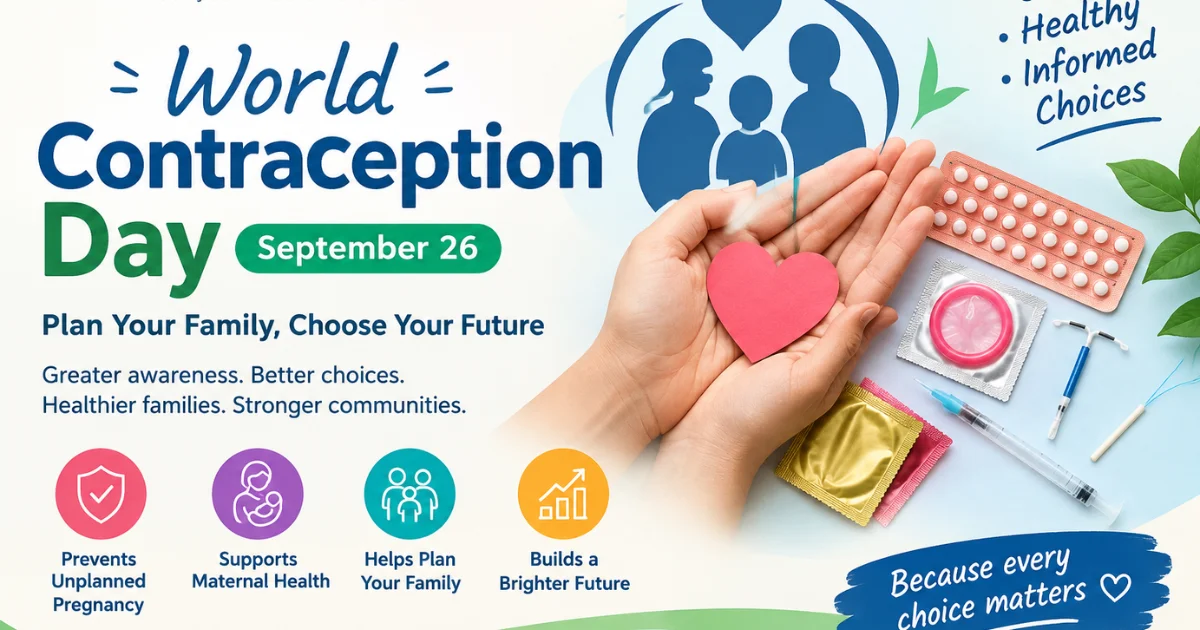
World Contraception Day is observed every year on September 26 to raise awareness about contraception, family planning, sexual and reproductive health, and the importance of making informed choices about pregnancy. The day provides an opportunity to discuss safe and effective contraceptive options and address common myths, misconceptions, stigma and barriers that prevent people from accessing family-planning services.
Contraception is not simply about preventing pregnancy. Access to appropriate contraception can help individuals and couples decide whether, when and how many children they want to have, while supporting maternal health, family well-being and broader social and economic opportunities. The World Health Organization (WHO) recognizes access to contraceptive information and services as an important part of health and human rights.
When Is World Contraception Day?
World Contraception Day is observed annually on September 26. It focuses on improving awareness about different contraceptive methods and encouraging people to obtain accurate information from qualified healthcare professionals.
For 2025, WHO South-East Asia highlighted the theme “A choice for all. Freedom to plan, power to choose.”
For 2026, the broader focus remains particularly relevant as health organizations continue working to expand access to safe, affordable and evidence-based contraception.
What Is Contraception?
Contraception refers to methods used to prevent pregnancy. Depending on the method, contraception may work by preventing ovulation, blocking sperm from reaching an egg, preventing fertilization or providing a long-term method of pregnancy prevention.
There are several contraceptive choices, and no single method is appropriate for everyone. Factors such as age, health conditions, medications, reproductive goals, convenience, possible side effects and personal preferences can influence which method may be suitable.
WHO emphasizes that people should have access to a range of safe and effective options so they can make informed decisions about contraception.
Why Is World Contraception Day Important?
Unplanned and unintended pregnancies can have significant health, social and economic consequences. Family planning allows people to plan pregnancies and space births according to their individual circumstances.
According to WHO, among approximately 1.9 billion women of reproductive age (15–49 years) worldwide in 2021, around 1.1 billion had a need for family planning. Of these, 874 million were using modern contraceptive methods, while 164 million had an unmet need for contraception.
Improving access to contraception can help:
- Prevent unintended pregnancies
- Support healthy spacing between pregnancies
- Reduce health risks associated with some high-risk pregnancies
- Reduce the need for unsafe abortion
- Support women’s education and employment opportunities
- Help couples plan the size and timing of their families
- Promote informed reproductive-health decisions
Contraception therefore has implications beyond individual pregnancy prevention—it can contribute to healthier families and communities.
Common Types of Contraceptive Methods
There are several temporary and permanent contraceptive options available.
1. Condoms
Male and female condoms are barrier methods that help prevent sperm from reaching the egg. Importantly, condoms are the only contraceptive method that also helps protect against sexually transmitted infections (STIs), including HIV.
They should be used correctly and consistently during sexual activity.
2. Oral Contraceptive Pills
Birth-control pills contain hormones that primarily prevent ovulation and can also change cervical mucus and the uterine lining.
There are different types, including combined oral contraceptive pills containing estrogen and progestin and progestin-only pills. They need to be taken according to the prescribed schedule for maximum effectiveness.
Women considering oral contraceptives should discuss their health history and individual risk factors with a healthcare professional.
3. Intrauterine Devices (IUDs)
IUDs are small devices placed inside the uterus by a trained healthcare provider.
There are two broad types:
- Copper IUDs, which do not contain hormones
- Hormonal IUDs, which release a progestin hormone
They can provide long-term, reversible contraception. The duration varies depending on the specific device.
4. Contraceptive Implants
Implants are small flexible devices placed under the skin of the upper arm by a trained healthcare provider. They release a progestin hormone and can provide protection for several years, depending on the product.
They are reversible and may be an option for people who prefer a long-acting method without having to remember a daily pill.
5. Injectable Contraceptives
Some contraceptive injections contain progestin and provide pregnancy prevention for a limited period, commonly a few months depending on the formulation.
The timing of repeat injections is important, so users should follow the schedule recommended by their healthcare provider.
6. Permanent Methods
For people who are certain that they do not want future pregnancies, permanent methods such as vasectomy or female sterilization may be considered.
These procedures are intended to be permanent and should therefore be discussed carefully with an appropriately trained healthcare professional.
Emergency Contraception
Emergency contraception can be used after unprotected sex or when contraception has failed. Options include emergency contraceptive pills and the copper IUD.
WHO states that emergency contraceptive methods should be used within five days of unprotected sex, with effectiveness generally improving when they are used sooner.
Emergency contraception should not be confused with regular contraception, and it does not protect against sexually transmitted infections.
Contraception and Sexually Transmitted Infections
One important point often misunderstood is that most contraceptive methods prevent pregnancy but do not protect against STIs.
Condoms provide protection against both pregnancy and many sexually transmitted infections when used correctly and consistently. People who may be at risk of STIs should discuss appropriate prevention, testing and treatment with a healthcare professional.
Breaking Common Myths About Contraception
Misinformation can prevent people from choosing contraception appropriately. Some people may avoid contraception because of fear of side effects, misinformation, social pressure or previous negative experiences.
For example, WHO notes that modern contraceptive methods do not cause infertility. Fertility generally returns after stopping reversible contraceptive methods, although the timing can vary depending on the method and individual circumstances.
However, this does not mean every method is suitable for every person. Some medical conditions can affect which contraceptive options are appropriate. A healthcare professional can help assess individual circumstances.
The Role of Men in Family Planning
Family planning is not only a women’s responsibility. Men also have an important role in contraception and reproductive health.
Partners can discuss:
- Whether they want children
- When they want to have children
- How many children they want
- Which contraceptive method may work for them
- STI prevention
- Shared responsibility for contraception
Open communication between partners can help reduce misunderstandings and improve informed decision-making.
Contraception and Young People
Adolescents and young adults may face particular barriers to obtaining accurate sexual and reproductive-health information. These can include embarrassment, stigma, lack of confidential services and misinformation.
Providing age-appropriate, medically accurate education can help young people understand reproductive health, consent, STI prevention and available healthcare services.
Healthcare services should provide appropriate confidentiality, respectful communication and evidence-based information according to applicable laws and professional standards.
Improving Access to Contraception
Despite the availability of many contraceptive methods, access is not equal everywhere. WHO identifies barriers including limited availability, limited choice, concerns about side effects, cultural or religious opposition, poor-quality services and gender-related barriers.
Improving access requires more than simply making contraceptive products available. People also need:
- Accurate and understandable information
- Trained healthcare professionals
- Affordable services
- A choice of appropriate methods
- Privacy and respectful care
- Reliable supplies
- Follow-up and counselling when required
In September 2026, WHO also announced guidance aimed at expanding access to a wider range of safe contraceptive options, including emergency contraception and longer-lasting implants, emphasizing informed choice and access to evidence-based methods.
How Can We Observe World Contraception Day?
World Contraception Day can be observed by spreading accurate information about reproductive health and family planning.
Hospitals, clinics, schools, healthcare organizations and community groups can organize:
- Awareness campaigns
- Family-planning counselling sessions
- Educational seminars
- Women’s health programmes
- STI-awareness activities
- Myth-versus-fact campaigns
- Information sessions for couples
- Healthcare-provider consultations
Social media can also be used to share reliable information from trusted medical and public-health organizations.
Final Thoughts
World Contraception Day is an opportunity to encourage knowledge, informed choice and access to quality reproductive-health services. Contraception can help prevent unintended pregnancies, support healthy pregnancy spacing and allow individuals and couples to plan their families according to their own circumstances.
There is no single contraceptive method that is perfect for everyone. The appropriate choice depends on individual health, reproductive goals, preferences and other circumstances. People should speak with a qualified healthcare professional before starting, changing or stopping a contraceptive method.
Most importantly, conversations about contraception should be based on accurate medical information rather than fear, myths or stigma. Improving awareness and access can help people make informed decisions about their reproductive health and contribute to healthier families and communities.
World Contraception Day – September 26: Know your options, get accurate information, and make informed reproductive-health choices.
Latest Post
- World Contraception Day 2026 Importance, Methods, Benefits and the Need for Better Awareness
- World Physiotherapy Day Importance, Benefits, and the Role of Physiotherapy in Better Health
- World Sexual Health Day Promoting Awareness, Safety, Respect, and Healthy Relationships
- Gujarat Health Machinery Placed On High Alert Following Chandipura Virus Outbreak
- International Overdose Awareness Day 2026 Meaning, Importance, Overdose Prevention & Awareness